WASM2HLSL for UdonSharp
Run WebAssembly on the GPU in a VRChat world. Drop a .wasm file into the project and the editor
translates it to HLSL; an UdonSharp WasmGpuRunner then executes the exported function once per pixel
of a render texture and reads the results back into Udon.
See Documentation~/GettingStarted.md for a step-by-step guide.
Install
VRChat Worlds SDK 3.10.5 is required (it includes UdonSharp). Add this repository as a package
(Unity Package Manager > Add package from git URL, or clone it into Packages/).
Udon is slow (roughly 1000× slower than C#). A pixel shader running the same logic over thousands of pixels in parallel is not. This package lets you write that logic in Rust/C/Zig instead of hand-written HLSL.
Pipeline
kernel.rs ──rustc──▶ kernel.wasm ──(import)──▶ inside the .wasm asset, per export: shader + material + render texture
WasmGpuRunner (U#): args/SetInput → VRCGraphics.Blit → VRCAsyncGPUReadback → int[] resultLo
Quick start
-
Write a kernel. Parameter 0 (if
i32) receives the pixel index; the others are arguments you set from Udon by name. Export as many functions as you like. The comment above each one is its inspector help, and two tags set it up:@size W x H(or@size Nfor N calls) is how many calls oneRun()makes, and@trapsturns on Trap Check.#![no_std] #[panic_handler] fn panic(_: &core::panic::PanicInfo) -> ! { loop {} } #[link(wasm_import_module = "env")] extern "C" { fn input(i: i32) -> i32; // optional: reads SetInput() data fn hlsl_sin(x: f32) -> f32; // optional: native GPU math } /// Multiplies each input word by `scale`. /// @size 256x256 #[no_mangle] pub extern "C" fn main(id: i32, scale: i32) -> i32 { unsafe { input(id) } * scale } /// One sine sample per call. /// @size 48000 @traps #[no_mangle] pub extern "C" fn tone(id: i32, freq: f32) -> f32 { unsafe { hlsl_sin(id as f32 * freq * 0.000130899) } } -
Build with a small stack (GPU memory lives in registers, see limits):
RUSTFLAGS="-C link-arg=-zstack-size=4096 -C target-cpu=mvp -C target-feature=+bulk-memory,+sign-ext,+nontrapping-fptoint" cargo build --release --target wasm32-unknown-unknownAdd
,+simd128(and,+relaxed-simd) to the features to usecore::arch::wasm32SIMD. -
Copy the
.wasmintoAssets/. Nothing else is created: the shader, material and render texture live inside the.wasmasset (expand it in the Project window to see them). -
Drag the
.wasminto the Hierarchy or Scene view. You get a GameObject with a readyWasmGpuRunnerthat holds every exported function. Its inspector has: the.wasm, Function (the oneRun()calls), its arguments under their source names, Size and Trap Check (locked when@size/@trapsset them), and Test (runs it on the GPU without Play Mode). -
Call it from your U# script:
public WasmGpuRunner runner;
void Start()
{
    runner.callbackTarget = this;
    runner.SetFunction("main");            // or keep the inspector's Function
    runner.SetNamedArgInt("scale", 3);     // or SetArgInt(1, 3): wasm parameter index
    runner.SetInput(myData);
    runner.Run();                          // RunFunction("tone") = SetFunction + Run
}
public void OnWasmComplete() { Debug.Log(runner.resultFunction + ": " + runner.resultLo[0] + (runner.trapped ? " (trapped)" : "")); }
One function runs at a time per runner (
busy); each function keeps its own argument values.
Names from source
Release wasm keeps function names but drops parameter names, so they are read from the source next to the .wasm
(its folder and src/; point Source Path in the .wasm import settings elsewhere if needed). Source in the project
reimports the .wasm when it changes. Recognised exports:
| Language | Export | Rename |
|---|---|---|
| Rust | pub extern "C" fn name(a: i32) | #[export_name = "x"] |
| C / C++ | any function definition int name(int a) | __attribute__((export_name("x"))) |
| Zig | export fn name(a: i32) i32 | |
| AssemblyScript | export function name(a: i32): i32 | |
| TinyGo | //export name or //go:wasmexport name above func |
Without source, arguments are called arg1, arg2, … and Size / Trap Check come from the import settings.
Output layout
| Export returns | Read with |
|---|---|
i32 | resultLo[i] |
f32 | resultFloat[i], read back natively with no per-value Udon loop, so millions of results are fine |
f64 | resultFloat[i] (rounded to f32: Udon reads floats; compute in f64, return what you need) |
i64 | resultLo[i] (low 32 bits), resultHi[i] (high 32 bits) |
funcref / externref | resultLo[i]: function index, -1 = null |
Arguments: i32/i64/refs are set with SetArgInt, f32/f64 with SetArgFloat (an f64 argument is a float widened exactly;
pass a double as two floats, hi = (float)d and lo = (float)(d - hi), and add them in f64 when you need all its bits, see Example/DeepZoom).
v128 can’t be an export parameter or result (Udon has no 128-bit value); such exports are skipped with an import warning.
To skip readback entirely, show the render texture: WASM2HLSL/Int Display (in Example/) reads it as packed RGBA8 or an iteration palette.
Trap Check (@traps in source, the runner inspector, or the .wasm import settings) sets runner.trapped when any call hits unreachable,
divides by zero, calls a bad call_indirect slot, or loops more than W_MAX_LOOP_ITER (65536) times. That call returns 0.
It is off by default because it adds one more set of rows to read back.
How it works: AsyncGPUReadback only reads R32_SINT integer textures, so the render texture stacks planes of rows:
lo first, then hi (i64 only), then the trap flag (Trap Check only). Each pixel recomputes its call and writes its plane’s value.
Supported
Every WebAssembly value type:
| Type | On the GPU | Exact? |
|---|---|---|
i32 | uint | yes |
i64 | uint2, emulated (mul/div/rem/shift/rotate/clz/…) | yes |
f32 | float | GPU float (last-bit rounding may differ, div/sqrt within a few ulp, denormals may flush) |
f64 | uint2 holding the IEEE bits, software float (SoftFloat’s algorithms, round to nearest even) | yes, bit-exact incl. subnormals, div, sqrt, conversions |
v128 | uint4: all of SIMD (i8x16 … f64x2: arithmetic, saturating, compare, shifts, shuffle/swizzle, narrow/extend, extmul, dot, bitmask, lane load/store, conversions) plus relaxed SIMD (deterministic: min/max behave like x86 minps/maxps, the rest like the strict instruction) | integer and f64x2 lanes yes; f32x4 lanes like f32 |
funcref / externref | uint (function index, 0xFFFFFFFF = null) | yes |
- Full MVP instruction set, plus sign-extension, saturating truncation,
memory.copy/memory.fill, multi-value blocks. - Direct calls,
call_indirect(dispatched with anifchain), mutable globals, data segments. - Reference types:
ref.null/ref.is_null/ref.func, typedselect, ref locals/globals, multiple tables,table.get/set/size/grow(always fails, likememory.grow) /fill/copy/init,elem.drop. A table that code writes to is kept per pixel, andcall_indirectthrough it dispatches on the function stored there. - Imports:
input(i32) -> i32(raw words fromSetInput) and math mapped to HLSL intrinsics:hlsl_sin,hlsl_cos,hlsl_tan,hlsl_asin,hlsl_acos,hlsl_atan,hlsl_atan2,hlsl_sinh,hlsl_cosh,hlsl_tanh,hlsl_exp,hlsl_exp2,hlsl_log,hlsl_log2,hlsl_log10,hlsl_pow,hlsl_sqrt,hlsl_fmod,hlsl_fmin,hlsl_fmax, … (plainsinf/powfwork too in C, but Rust’s compiler_builtins links its own software libm for those names — use thehlsl_prefix).
Limits (by design of GPU shaders)
| Limit | Why | Workaround |
|---|---|---|
| No recursion | HLSL has no call stack; the converter errors with the cycle. | Rewrite as a loop. |
| ≤ 64000 bytes of writable memory | Linear memory is a per-pixel uint4 register array (fxc cap 4096 registers). The size is data end + stack, not the declared pages. Constant data does not count (see below). | -zstack-size=4096, small mutable statics, no heap. |
memory.grow always fails | Memory is fixed. | Use no_std without an allocator. |
f64 is slow | Quest/mobile GPUs have no doubles, so every f64 op is ~100 integer instructions (div/sqrt loop 55-63 times). Shaders using f64 compile slower: ~1 min for Example/DeepZoom, and fxc’s time grows faster than linearly, so one export using dozens of different f64 ops can take many minutes. | Use f32 where it is precise enough. Split big f64 kernels into several exports: each export compiles only the code it reaches. |
| Math imports run in f32 | hlsl_sin(f64) etc. call the GPU’s float intrinsic. | Write the function in f64 yourself when you need the precision. |
No threads, exceptions, GC, tail calls, memory.init / data.drop. | ||
| Large modules compile slowly | fxc inlines every function. A ~6 KB kernel takes ~10 s; Rust’s software libm (f32::sin via compiler_builtins) takes many minutes. | Use hlsl_* imports instead of libm; keep kernels small. |
Memory is private to each pixel and resets every run; pixels cannot talk to each other. Return values are the only output.
Big constant tables (no limit)
Read-only data (.rodata: static / const tables, strings, lookup tables) of 1 KB or more is read from a texture,
so it takes no registers and can be megabytes. It happens on import, with nothing to change in the source:
static PALETTE: [u32; 16384] = make_palette(); // 64 KB: over the register limit, fine as .rodata- The
.wasmasset gets aromtexture (RGBA32 linear, one word per texel, 4096 wide), already set as_WasmRomon every export’s material. The summary shows its size next to “GPU memory per call”. - Reads cost one texture fetch per word; registers stay faster for small hot tables. Import settings → Texture Constants From (bytes) sets the threshold (default 1024); 0 keeps everything in registers.
- Writing into it sets the trap flag (
.rodatawrites are undefined behaviour in Rust/C anyway). Mutablestatic mutdata stays in registers. - It needs the segment names in the wasm
namesection, whichcargo buildand clang keep.wasm-opt --strip/wasm-stripremove them; then everything stays in registers. - Tested:
Tests~/run.shmode 8 reads a 96 KB table (words, bytes, unaligned, copied to the stack and modified) bit-for-bit like Node.
Verified
Tests~/run.sh builds a Rust kernel (collatz loops, 64-bit hashing, match → br_table, 32/64-bit div/rem, an
in-memory sort, float math, i64↔float casts, input(), a 96 KB .rodata table read through the ROM texture), runs it as a D3D11 compute shader on 1024 invocations and
compares every result with Node’s WebAssembly: all integer paths are bit-exact; the hlsl_sin path differs by ≤ 1 ulp of the output.
The Mandelbrot sample (64 KB palette in the ROM texture) matches Node on 99.7% of pixels, and the rest differ only because hlsl_log2 is the GPU’s f32 log2.
A Unity Graphics.Blit of it is identical, pixel for pixel, to the D3D11 test.
Tests~/types.sh does the same for the other types, 4096 calls per export, all bit-for-bit with Node: scalar f64
(add/sub/mul/div/sqrt/min/max/compare/copysign on random doubles weighted toward subnormals, infinities, NaN, overflow and
cancellation; ceil/floor/trunc/nearest; every int↔f64 and f32↔f64 conversion), the SIMD instruction families of every lane shape
(i8x16, i16x8, i32x4, i64x2, f32x4, f64x2, lane loads/stores, relaxed SIMD where the result is not implementation-defined),
and a hand-assembled reftypes.wasm covering ref values and every table instruction. f32x4 div/sqrt are left out: like
scalar f32 they run at GPU float precision. Not yet tested on Quest/Vulkan.
Layout
Editor/   WasmModule.cs (parser), WasmToHlsl.cs (translator), WasmImporter.cs (.wasm importer), WasmGpuRunnerEditor.cs (drag & drop + inspector),
          SourceNames.cs (argument names, docs, @size / @traps from source), Icons/ (.wasm and runner icons)
Runtime/  WasmGpuRunner.cs (UdonSharp) + U# assembly definition
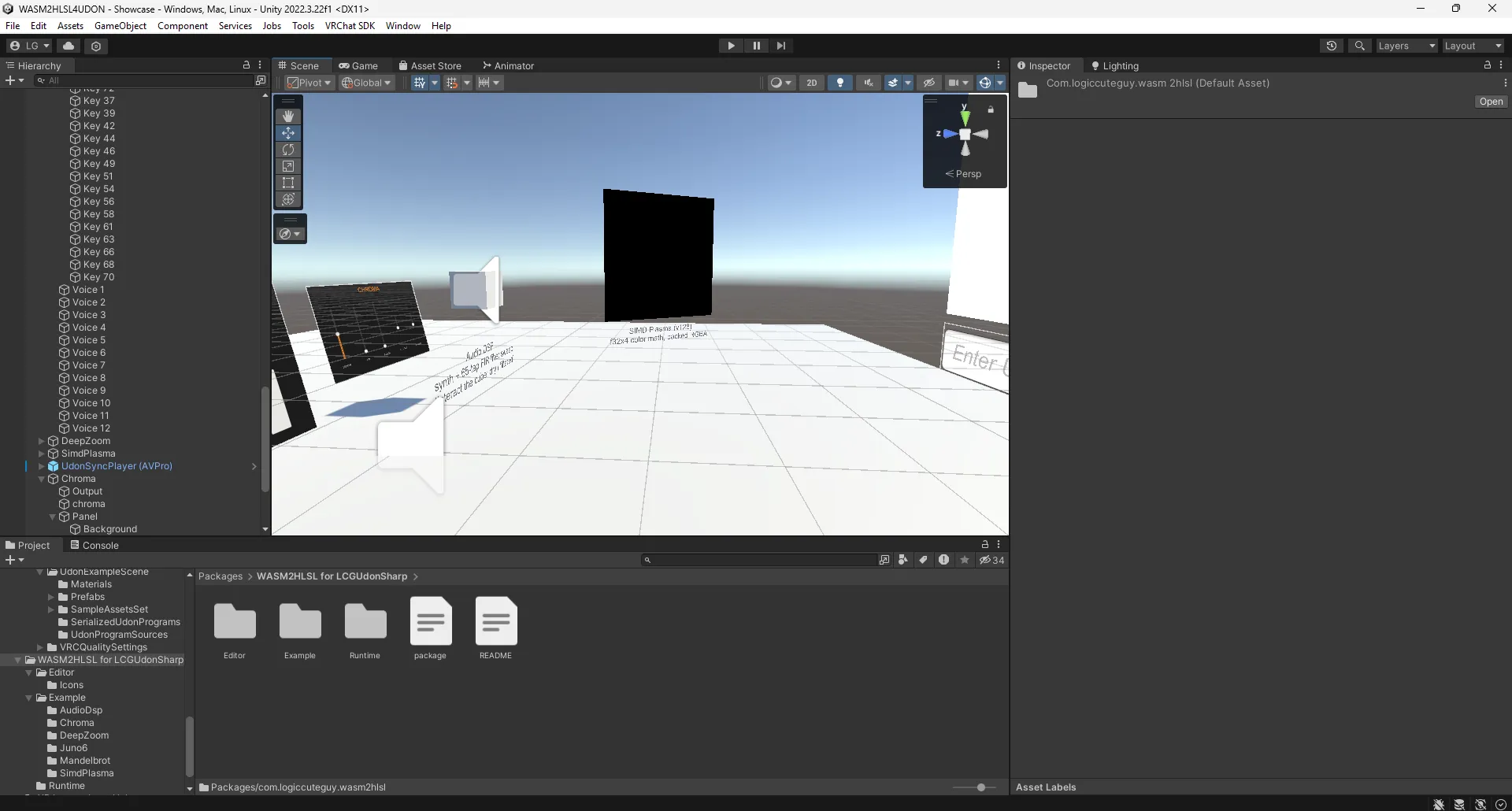
Example/  Showcase.unity (Mandelbrot, Juno-6 synth, AudioDsp, DeepZoom f64, SimdPlasma v128 in one VRChat world): open it and press Play
          (DeepZoom / SimdPlasma: run Tools > WASM2HLSL > Add f64 + SIMD Examples To Scene once, then save the scene)
          Chroma/: live scale-filter insert for the Juno-6 and a video player (setup menu: Assets/ChromaSetup/Editor/ChromaSetup.cs)
          WasmIntDisplay.shader (shows a runner's render texture without readback)
Tests~/   GPU conformance tests (Rust → wasm → HLSL → D3D11 vs Node): run.sh (MVP), types.sh (f64, v128, reference types)
          names/: source-name parser check per language (`dotnet run --project names`)
          chroma_check.js: Example/Chroma kernel self-check in Node (`node chroma_check.js ../Example/Chroma/chroma.wasm`)
License
MIT © LogicCuteGuy
Package Name
com.logiccuteguy.wasm2hlsl
Documentation
Undefined
Repositories
- LogicCuteGuy VPM Listing (4 versions)
Version
0.2.2
Unity version
2022.3 or later
Dependencies
No dependencies
VPM Dependencies
Legacy Packages
No legacy packages
License
Author
LogicCuteGuy